

The ''AI-Pet-Emotion'' Triad and Casio’s Unexpected Move
Beyond my grandfather's watch: Why a Japanese giant is betting on a fluffy, AI-powered experiment to stay relevant.


We will inevitably see artificial intelligence in every field and every corner of our lives. Concepts like “AI-Supported” or “AI-First” are becoming standard characteristics of every new or existing digital and physical product; this is quite normal.
However, one of the most debated topics is the attempt to squeeze AI into a “human-like or, on the flip side, animal-like” structure by trying to dress it in an “emotional shirt.” Sure, AI can be used for everything to make our lives easier. If we are moving 10 steps a day, AI can carry us x10 steps forward for humanity with its processing power and RAG (knowledge retrieval) capabilities. But what about the other side of the circle: treating AI as an emotional being?
This is something we are still heavily debating. Is it just an innocent curiosity, or is it trying to shift humanity’s perspective on living beings, specifically those with actual emotions and characters, in a different direction? In the end, will it transform our social relationships, whether with animals or humans, into a completely different dimension?
To be honest, we don’t know yet. But it’s clear that serious investments are being made. As always, these experiments happen with animals before humans, similar to how the first living being in space was a dog. While there is significant work on humanoid robots and brain chips, the most intense efforts to “embed emotion into a living form via AI” are happening with animals. I am sure we will see the definitive results within the next five years.
Casio: From My Grandfather’s Watch to an AI Companion
I must say, seeing an “AI Pet” (or as they call it, a “companion”) move from a watch brand really surprised me. In our minds, Casio is the reliable Japanese watchmaker we’ve known for decades. For me, it’s “my grandfather’s wristwatch” brand; it doesn’t exactly scream “innovative.” But Casio is a giant that also produces musical instruments and medical equipment, aiming to be not just on people’s wrists, but in their homes and lives, constantly trying to reinvent itself.
Casio is so determined to enter this space that they want to be part of our lives with a new “Powered by AI” perspective. I see this both in my research and in the way they’ve positioned their new AI companion, Moflin, right in the center of their global website’s main menu. The name Moflin is derived from “Moffu-Moffu” (a Japanese onomatopoeia for the feeling of touching something soft and fluffy) and “Life.”

Moflin is actually a very simple idea, almost a prototype for a giant brand like Casio to release. It has a basic hardware structure: gyroscopes, sound detection, touch sensors, and a simple 1200 mAh battery. Wrapped in a small plush fur, it looks like those old cat figurines. But here is where it gets interesting:
Moflin doesn’t use any popular language models like OpenAI or Google, and it isn’t even connected directly to the Cloud.
Moflin uses an embedded structure Casio calls “Adaptive Emotional AI” (developed in partnership with Vanguard Industries). This is about much more than Moflin being a “cute” housemate; in my opinion, Moflin is an experiment by the brand on producing emotion-based AI products.
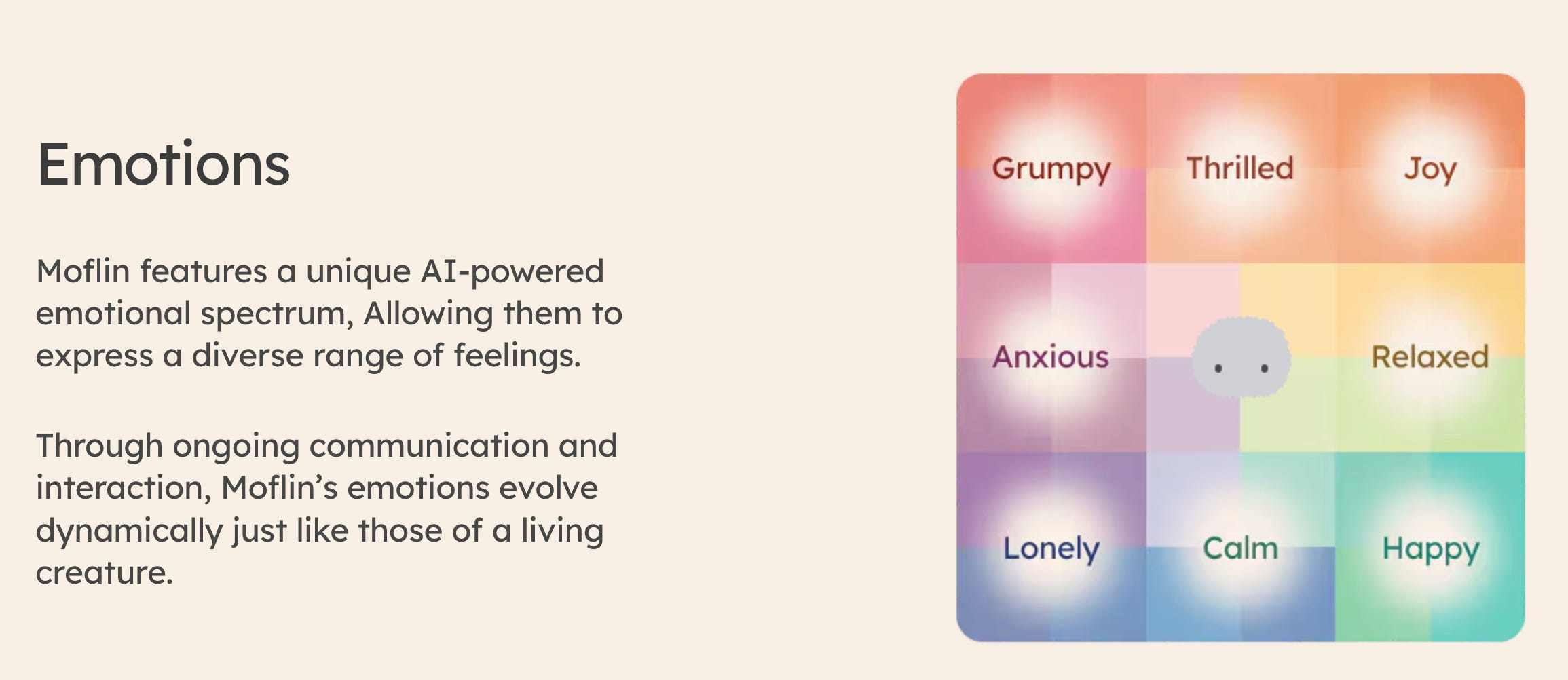
2D Emotion Map: Moflin’s inner world has a map that shifts across a wide spectrum from happiness to sadness, excitement to calmness.
Learning Process: It processes data from its sensors on this map. For example, if you treat it gently, it moves to the “happy and secure” zone; if neglected, it may feel “anxious or lonely.”
And the most fascinating part: Casio claims that every Moflin is different. Just like humans or animals... Moflin’s AI learns the owner’s behavior over time to create a unique personality, with over 4 million possible combinations. Instead of massive LLM datasets, it uses a machine learning structure that focuses solely on its interaction with you.
Backing Up a Robot’s Soul
While Moflin isn’t directly connected to the cloud, it connects via its mobile app, MoLife. If you allow it, you can track interaction logs (how much it was loved, when it was left alone) and emotional development data through the app.
The most striking point: if your robot breaks, you can buy a new Moflin and transfer the “soul” (the character developed so far) of your backed-up Moflin directly into the new one.
Vanguard, the company behind Moflin, introduced the concept of “Digital Biology” while designing it. They base this on two pillars:
Constant Evolution: Moflin doesn’t just react to fixed commands; it learns every day and develops a “biological rhythm.”
Crossing the Uncanny Valley: Moflin’s design intentionally doesn’t mimic a specific animal perfectly. This prevents our brains from asking, “Why isn’t this acting like a real rabbit?” and avoids that creepy feeling.
In Japan, they’ve even launched a subscription service called “Moflin Club,” offering everything from fur replacement to “check-ups.”
I am continuing to research this interesting new dynamism between human relationships and these innovative “living-form” AI products. If you own a Moflin, please reach out to me; I have a few questions I’d love to ask for this content. I look forward to your comments.