

The 90% Reality: Making the Responsible Choice the Easy Choice
A conversation with Robert Keus, CEO of GreenPT, on the hidden costs of AI, privacy architecture, and the responsibility of being a builder.

Look back at the last few years. AI has shifted from a niche topic at tech conferences to the constant companion of our daily work. Regardless of our role in the digital product world, whether we are product managers, developers, or designers, it is now impossible to imagine a product vision without AI. When planning a feature, optimizing code, or designing a user experience, we all ask the same question: “How can we make this better with AI?”
AI is no longer a luxury. It is a utility, like electricity for digital products. But as a Builder, I believe we have to question where and how we source this electricity. We usually choose the easiest path. We connect to a massive API, send the data, and get the answer. But what happens behind that magic box?
To ask these questions, I sat down with Robert Keus , the founder of GreenPT.
Blurple Studio, B Corp, and Shared Values
My connection with Robert actually goes back about four months. It was during the exciting period when Blurple Studio, the UX studio I founded, received its B Corp certification. For those who know, B Corp is not just a certificate. It is a stance. It is a commitment to using business as a force for good, not just for profit.
Connecting with Robert was no coincidence because he is trying to do exactly the same thing in the AI world. He is blending technology with ethics and sustainability.
So, What is GreenPT?
Before diving into the interview, let’s set the context. Calling GreenPT “just another AI tool” would be unfair. GreenPT is a privacy-first, sustainable AI platform designed for enterprise, hosted entirely in Europe.
What keeps it on my radar as a developer is that it is not just a wrapper. GreenPT is a full ecosystem that serves open-source models on its own optimized infrastructure while transparently showing where your data goes and how much energy it consumes.
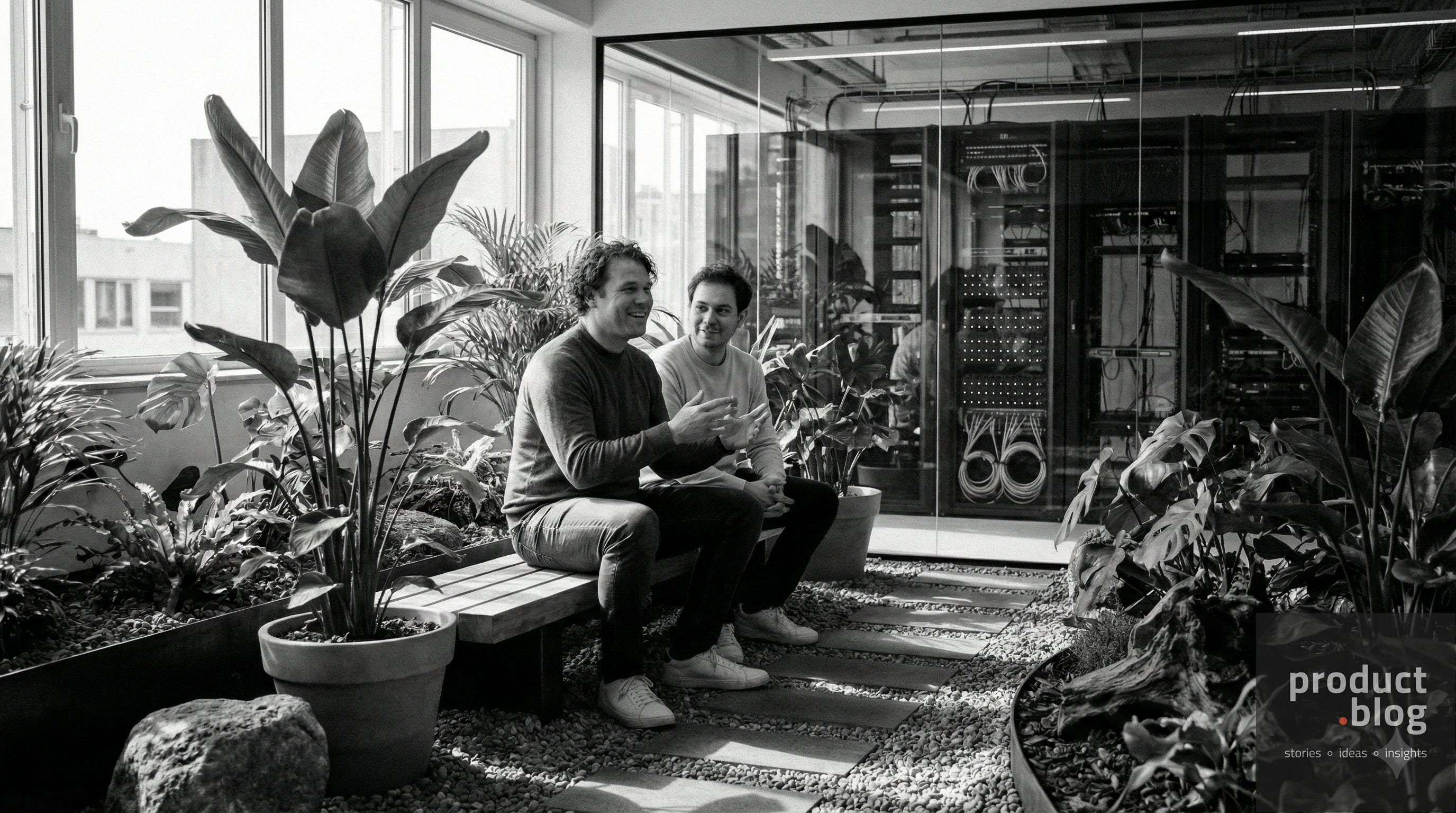
Robert and I did not actually meet in the sunny, green office shown in the image above. I was in Barcelona, and he was in The Netherlands. However, we asked an AI to imagine the transparent environment our conversation deserved. In that virtual setting, we discussed very real problems.
How It Started: “A Practical Frustration”
I started by asking Robert about the initial spark for GreenPT. He did not give me a philosophical speech. He described a practical engineering frustration.
AI adoption was moving fast, but the default setup was broken. It was usually US-hosted, opaque, energy-heavy, and hard to trust.
“I wanted a platform that makes the responsible choice the easy choice,” Robert told me.
His vision was clear. He wanted European hosting, privacy by design, and open technology that prevents vendor lock-in. Most importantly, Robert realized these values are not decorations. “These are not separate features,” he noted. “In real adoption, you cannot bolt them on later without compromises. They must be in the product DNA.”
Sustainability is a Stack, Not a Sticker
I asked Robert how the sustainability aspect of GreenPT works in practice. His answer showed that it is not about buying carbon offsets to clear your conscience. It is a stack of choices.
Renewable Energy: Picking infrastructure partners and regions, specifically in Europe, where energy sourcing is demonstrably cleaner. They also keep workloads close to users to reduce network overhead.
Efficient Model Selection: Instead of using heavy models for everything, the default is to use smaller, strong open models for everyday tasks.
Optimization: They use quantization, caching, and smart context handling. If a shorter context works, the system does not reprocess huge prompts.
Operational Guardrails: The platform steers users toward “good enough” and efficient outputs instead of always using maximum compute.
A Privacy-First Architecture
In the B2B world, trust is an architectural requirement, not a marketing slogan. So I asked about their privacy design. Robert’s answer relied on a single principle: Data Minimization.
“Do not collect what you do not need, and do not store what you cannot justify,” he said.
This principle translates into concrete decisions at GreenPT:
European Hosting: For predictable jurisdiction and GDPR alignment.
Transparent Data Handling: Clear rules on what is logged and what is retained.
Zero Tracking: A strict product stance.
Robert emphasized that if you want organizations to use AI in real workflows, the architecture must stand up to security and compliance scrutiny without vague excuses.
Open Source and the 90% Rule
One of Robert’s most striking observations concerned the efficiency of open-source models. In an era where everyone is chasing the largest proprietary model, Robert argues that we are over-computing.
“90% of AI tasks can be handled by open models,” he stated.
He sees this in daily work. Summarizing, rewriting, searching a knowledge base, drafting, or simple classification. For these tasks, open models are often better than the giants. “The advantages are huge,” Robert said. “Lower cost, more control over data, deployment flexibility, and fewer compliance headaches.”
Why a “Full Stack” Platform?
I asked why he describes GreenPT as a full stack platform rather than just a chat interface. He explained the layers involved:
Chat: For human-friendly interaction.
API Access: So teams can embed GreenPT into apps and internal tools.
Model Routing: To ensure the right model is used for the right job.
Real-time Insights: To measure CO2 and energy usage, making sustainability a feedback loop inside the product.
The Roadmap and Future Goals
What comes next? Robert shared the roadmap in two parts. Product-wise, they are building better routing between open and premium models, stronger governance controls for organizations, and more connectors for internal data retrieval.
Movement-wise, they are pushing for shared standards around measuring AI energy impact. They want to help buyers ask better questions, such as “Where is this hosted?” and “Can I switch providers?”
The Trust Gap and PitchAI
Finally, I asked about the core problem they are determined to solve as AI adoption grows. Robert identified the biggest gap as trust with accountability. Many tools are impressive but unclear on data handling. GreenPT aims to close that gap by making privacy and transparency operational defaults.
We ended our chat by discussing PitchAI, a recent project where GreenPT helped younger participants refine business pitches using AI. It was a perfect proof of concept. It provided a safe environment where young creators could explore AI without tracking or data ambiguity.
As I finished the call and returned to my own development work, the lesson was clear. Efficiency and privacy are not barriers to innovation. In fact, they are the only way to build a better, more reliable digital product.